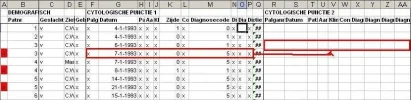
Hallo, ik heb mijn vraag ook op een Engels forum gepoat, daarom mijn tekst in het Engels:
I have database with diagnostic procedures of patients (patient numbers in column B: may be double or even triple). If two or more procedures of one patient exist, I would like them to be joined into one row, but only under certain circumstances.
The cells F-P (=all important data of the procedure) of the double row should be moved 12 cells to the right and 1 row up, so that it ends up in the same row as the first procedure of the same patient. Accordingly, cells F-P of a triple patient number should be moved 22 cells to the right and 2 cells up.
The cells should be moved only:
- If the cell of column B contains a double or triple patient number
- If the date of the procedure (cell G) is less than 3 months later than the first procedure of that patient (number)
- If cell K equals cell K of the row above
- Not if cell M of the first row of the patient = 5
Hopelijk is alles duidelijk!
Mvgr Barmless
I have database with diagnostic procedures of patients (patient numbers in column B: may be double or even triple). If two or more procedures of one patient exist, I would like them to be joined into one row, but only under certain circumstances.
The cells F-P (=all important data of the procedure) of the double row should be moved 12 cells to the right and 1 row up, so that it ends up in the same row as the first procedure of the same patient. Accordingly, cells F-P of a triple patient number should be moved 22 cells to the right and 2 cells up.
The cells should be moved only:
- If the cell of column B contains a double or triple patient number
- If the date of the procedure (cell G) is less than 3 months later than the first procedure of that patient (number)
- If cell K equals cell K of the row above
- Not if cell M of the first row of the patient = 5
Hopelijk is alles duidelijk!
Mvgr Barmless